Practice Patients, Real Stakes: The Simulation Labs Where Psych Nurses Rehearse for the Unthinkable
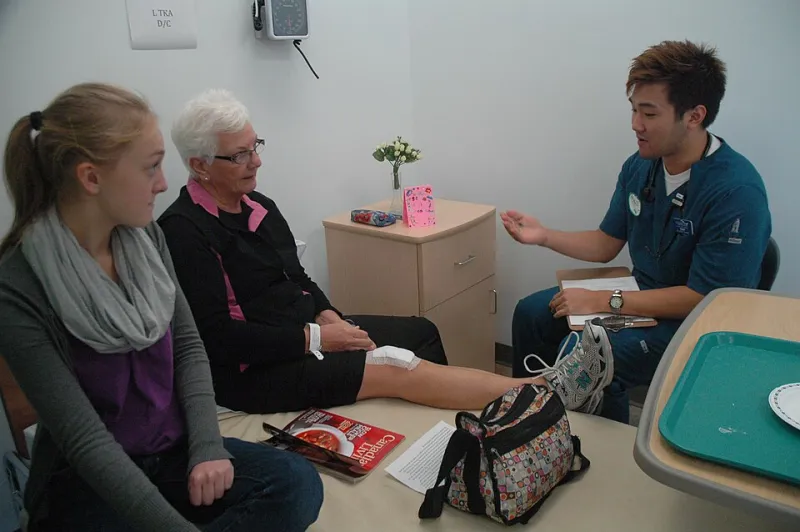
Photo: University of the Fraser Valley, CC BY 2.0, via Wikimedia Commons
The patient in Room 4 hasn't slept in three days. He's been off his meds for a week, he's told two staff members he has a plan, and right now he's behind a locked door, refusing to open it.
For the three nurses watching from behind a one-way mirror, none of it is real. The patient is an actor — a retired paramedic named Dave who teaches crisis communication at a community college outside Columbus. The room is a simulation lab at a university nursing school, complete with a fake door, hidden microphones, and a control room where an educator can pipe in sounds of banging or crying on cue.
But the heartbeat pounding in the ears of the nurse inside the room? That's real.
Rehearsal Has Always Been a Medical Thing. Just Never Ours.
Ask any ICU nurse about mock codes and they'll shrug. Practicing compressions on a manikin, running through a dead-patient drill, debriefing what went wrong — it's been baked into American critical care culture for decades. ER teams run mass-casualty drills. Labor and delivery units rehearse shoulder dystocia scenarios until the response is muscle memory.
Psychiatric nursing? For most of the profession's history, you learned by doing. Your first barricaded patient was, well, your first barricaded patient. Your first serious suicide risk assessment happened with an actual human being whose life depended on questions you'd never asked anyone before.
That's starting to change, and the nurses pushing for it say it's about time.
Meet the Educators Building the Worst Day on Purpose
Dr. Yvonne Castellano, a psychiatric nurse practitioner turned simulation educator, runs a program where nursing students and practicing RNs face scripted scenarios built from real unit incidents — de-identified, of course. A patient mid-crisis who's just flushed her meds. A family member in the waiting room escalating fast. A colleague who freezes during a restraint situation.
"We're not teaching nurses to be therapists in fifteen minutes," Castellano says. "We're teaching them that when their stomach drops, they have a sequence. They've been here before."
The scenarios are unflinchingly specific. In one, the standardized patient — someone trained to stay in character no matter what — has barricaded himself and is describing a plan aloud. The nurse inside has to run a genuine risk assessment, negotiate, and decide when to call for help, all while an educator tracks their word choices from the control room.
The debrief afterward, participants say, is where the learning actually happens. Nurses watch their own recordings. They hear the moment they started talking faster. They notice when they stopped listening and started managing.
What Actors Learn About Playing Patients
Standardized patient work in psych simulation is a strange craft. Unlike a manikin that codes on command, a human actor has to portray despair, hostility, or confusion convincingly — and then shake it off before the next session.
Dave, the retired paramedic, describes it as "emotional interval training." He's played a grieving widower, a teenager brought in involuntarily, and a veteran in crisis more times than he can count. The best actors, educators say, do more than recite a script. They improvise. They push back. They say the thing the nurse wasn't ready to hear.
And crucially, they give feedback from the other side of the encounter. "You asked me about my plan four different ways," one actor told a participant during a debrief. "The third time is when I actually heard you."
No manikin can do that.
The Case for Parity
Here's the argument the simulation movement keeps making, and it's hard to dismiss: we would never send a code blue untrained. We've built entire industries around rehearsing physical emergencies. But psychiatric emergencies — which kill Americans at staggering rates and land hundreds of thousands in ERs every year — have historically been learned live.
Simulation advocates aren't blaming anyone. Psych units are stretched thin, education budgets are tighter than ever, and there's no national standard requiring scenario-based psych training for practicing nurses. But the gap is real, and the nurses who've been through these labs describe the difference in almost identical language: I stopped dreading the call I couldn't predict.
There's a wellness angle here, too, and it matters. Anxiety about the worst-case scenario doesn't stay at work. It follows nurses home. Rehearsal doesn't just improve patient outcomes — it gives nurses back a sense of control that chronic uncertainty quietly strips away.
Not Every Hospital Has a Lab. Yet.
The honest caveat: high-fidelity simulation is expensive. Purpose-built labs, trained standardized patients, educator time — it adds up fast, and community hospitals and rural facilities, where psychiatric care is often most stretched, are the least likely to have access.
But the field is adapting. Low-cost versions are spreading: tabletop scenarios, role-play using colleagues, virtual reality modules, and regional simulation centers that host nurses from multiple facilities. State nursing boards and hospital systems are beginning to fund psych-specific simulation as part of workplace violence prevention and retention efforts — a rare case where recruitment math and clinical quality point the same direction.
For nurse educators reading this: you don't need a million-dollar lab to start. You need a scripted scenario, a willing colleague to play the patient, a private room, and the discipline to debrief honestly afterward. Programs across the country started exactly that way.
The Point Isn't Perfection. It's Preparation.
Back in the Columbus lab, the nurse finishes the barricade scenario, exhales hard, and joins the debrief. She missed a chance to reflect the patient's feelings back. She caught herself reaching for the door handle too early. She'll run it again next month.
"Every time I do this," she says, "I think about the first real one I ever handled. I did fine. But I was guessing the whole time."
Nobody should have to guess. Psych nurses hold some of the hardest, most consequential conversations in American healthcare — and the growing simulation movement is simply making the case they've deserved all along: the same rigorous rehearsal, the same respect, the same chance to practice the worst day before it arrives.
The patients they'll face are real. The preparation, finally, can be too.