The 3 A.M. Economy: How a Psych Unit's Snack Drawer Tells the Real Story of American Nursing
Every psych unit in America runs on two currencies. The first is trust. The second is snacks.
Nobody posts the rules. Nobody assigns a treasurer. And yet, somewhere between the med room and the staff bathroom, there's almost always a drawer — or a shelf, or a Tupperware graveyard — that functions as an open pantry for anyone whose stomach is growling at hour nine of a twelve-hour shift.
We spent weeks talking with nurses across the country about their units' snack cultures, and what we heard was funny, touching, and occasionally a little alarming. Because the break room fridge, it turns out, is a diagnostic tool. It tells you exactly how a unit is doing.
The Unwritten Ledger
Ask a night-shift nurse about the snack drawer and you'll hear the same phrase over and over: we keep track. Not on paper. In their heads.
"I brought a case of those peanut butter crackers in January," a nurse from a behavioral health unit in Ohio told us. "Nobody said thank you formally, but I have not bought a granola bar since. That's the deal."
This is the unwritten ledger — a mutual aid system that runs on memory and goodwill. A nurse from Arizona described leaving a sleeve of Girl Scout Cookies in the break room and finding a homemade breakfast burrito in the staff freezer two days later, no note attached. "That's how we talk out here," she said. "Food is the language."
It sounds charming. It is. But it's also worth asking why a workforce responsible for some of the most emotionally demanding care in medicine is quietly feeding itself.
What the Fridge Knows
Look closely at a unit's break room and you can read its recent history.
A fridge full of labeled leftovers from three different households? That's a unit where somebody just had a baby, or a death in the family, or a brutal stretch of shifts — and the crew rallied with casseroles the way previous generations rallied with casseroles, because it's the one gesture that never requires the recipient to say the right thing back.
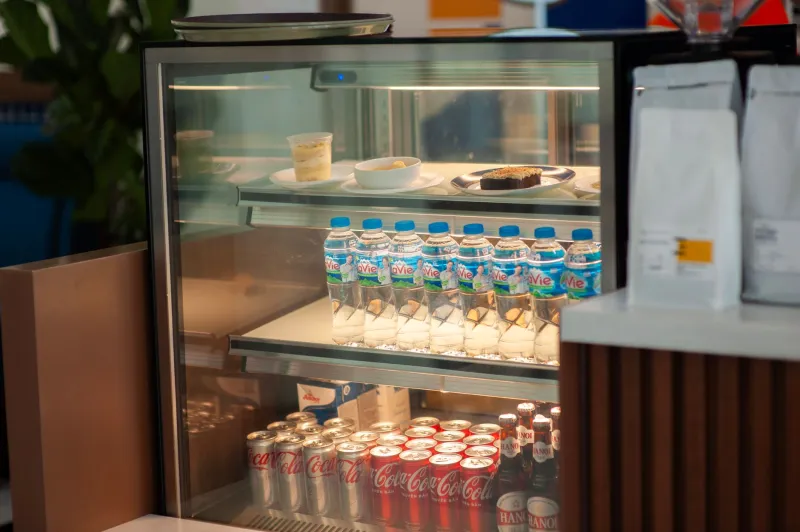
A drawer stocked exclusively with vending-machine purchases? Often a sign of a unit that's running so lean nobody has energy to shop, let alone cook.
And the 3 a.m. trade — the half sandwich handed across the nurses' station, the "take the rest of my soup, I can't finish it" — that's the signature of the overnight shift. Night staff on psych units describe a particular bond, forged in the long dark hours when the day crew is home and the census is high and the code bell could go off at any moment. Food gets shared the way sailors share watches. It's not charity. It's crew maintenance.
The Part That Isn't Charming
Here's the uncomfortable layer underneath the warmth: the snack economy exists, in large part, because breaks don't.
Nurses we spoke with described meals eaten standing up, lunches interrupted by codes, and a habit of packing food they could eat in ninety seconds with one hand. The granola bar isn't a preference. It's a workaround.
When a unit's snack drawer becomes load-bearing infrastructure — when the real answer to "how do you get through a shift" is "other people's leftovers" — that's not just camaraderie. That's a system running on the goodwill of its most exhausted people. Burnout doesn't always announce itself with dramatic exits. Sometimes it looks like a break room where nobody has brought anything new in weeks, because nobody has anything left to give.
The nurses who talked to us love their snack rituals. They also want it on the record that affection between colleagues is not a substitute for adequate staffing, real breaks, and admin that notices when the fridge is empty.
The Good News Hiding in the Drawer
Still, there's something genuinely worth celebrating here. In an era when healthcare workers report feeling increasingly invisible, the snack economy is proof that psych nurses are seen — by each other, every single shift, in the smallest possible ways.
A traveling nurse told us she gauges her new assignments by the break room within her first week. "If there's a drawer, I relax," she said. "If the fridge is a science experiment and nobody talks, I know it's going to be a long thirteen weeks."
Camaraderie isn't a soft skill on a psych unit. It's a safety system. The nurse who hands you a granola bar at 3 a.m. is also the nurse who'll have your back during a code, notice when you're dissociating at the station, and cover your patients when you finally take that bathroom break.
Show Us Your Snack Drawer
Which brings us to you.
For this year's Nurses Day coverage, we're building a feature on America's psych unit snack cultures — the shared shelves, the legendary casseroles, the trades, the traditions, the one coworker who always stocks the good chocolate.
Send us a photo of your unit's snack drawer or break room shelf, along with the story behind it. What's the most legendary food moment in your unit's history? Who's the unsung snack hero on your floor? What does your fridge say about your crew?
Email your photos and stories through our contact page with the subject line "Snack Diaries." We'll feature a selection ahead of Nurses Day — first names and units only, nothing identifying patients, and we'll confirm details with you before publishing.
The drawer by the med room might seem like a small thing. But small things, shared at 3 a.m., are how the people who hold up America's mental health care system hold each other up, too. We'd love to see yours.