What's Hanging From Your Lanyard? The Tiny Artifacts That Tell a Psych Nurse's Whole Story
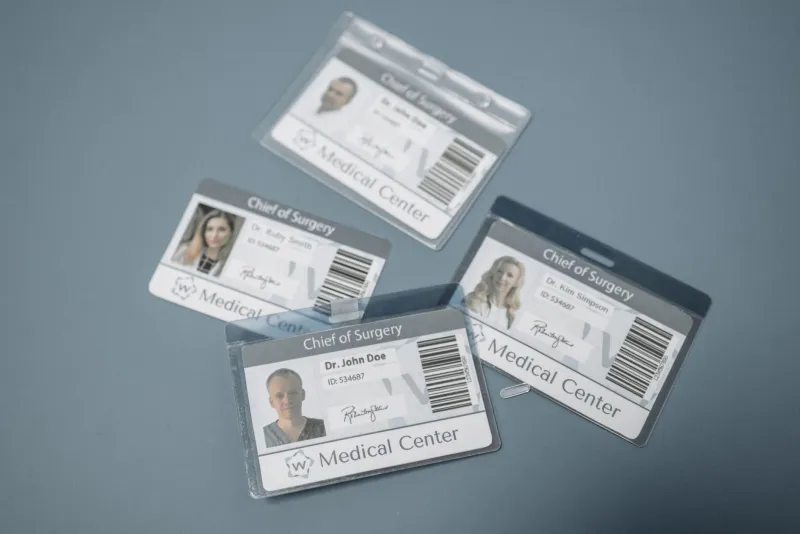
Look closely the next time a psychiatric nurse badges through a unit door. Sure, there's the official hospital ID, the one with the photo taken on a bad hair day in HR's borrowed corner. But look a little lower — at the laminated scrap, the dog-eared card, the tiny pin pushed through the fabric of a lanyard — and you'll find something the hospital never issued.
These little objects are everywhere in American psych units. And nobody plans to keep them. They just... stay.
The Student ID That Refuses to Retire
Take Marcus, an RN we spoke with who's been working behavioral health in Ohio for fourteen years. Still clipped to his badge reel: a student ID from his community college nursing program, the photo so washed out it looks like a Polaroid left on a dashboard.
"My wife keeps asking why I don't just toss it," he says, laughing. "I tell her that was the semester I figured out I belonged on a psych unit instead of a med-surg floor. That card got me into my first clinical rotation. It feels weird to act like that didn't matter."
He's not alone. In informal conversations with nurses from coast to coast — Washington to Florida — the same pattern keeps surfacing. Long after the credentials pile up and the alphabet behind the name gets longer, the earliest artifacts of the journey stay put.
There's something quietly stubborn about it. The field of psychiatric nursing asks professionals to constantly look forward: new interventions, updated protocols, evolving diagnostic frameworks. The lanyard, apparently, is where nurses give themselves permission to look back.
More Than Nostalgia: Milestones the Resume Skips
A resume lists jobs. A lanyard lists turning points.
Consider the first temporary license printout — that flimsy piece of paper many state boards of nursing issue before the official card arrives. For plenty of new grads, it's the first physical proof that they made it. It's also, conveniently, wallet-sized and laminatable.
Then there are the unit anniversary pins. Some hospitals hand them out at five, ten, twenty years of service, and while a few nurses tuck them into jewelry boxes, others punch them straight through their badge holders. A small enamel pin on a lanyard says something a LinkedIn profile never will: I stayed. Through the pandemic, through the staffing crises, through the nights no one talks about at parties — I stayed.
One nurse in Arizona keeps a tiny paper crimped under her badge clip — a thank-you note from a former patient, folded down to the size of a postage stamp. She's careful to note it contains no identifying information, nothing that would raise a HIPAA eyebrow. "It's the only thing I've kept from thirty years on the unit," she says. "Some days, on a hard one, I touch it just to remember why."
A Quiet Counterweight to a Heavy Job
Psychiatric nursing carries a particular kind of emotional load. Nurses in this field routinely witness crisis, hold space for people in their worst moments, and absorb a level of verbal and sometimes physical strain that other specialties rarely see. Burnout in behavioral health is well documented, and self-care advice tends to run toward the generic — sleep more, hydrate, take your PTO.
But maybe identity is part of the wellness equation too. Psychologists have long noted that tangible objects can anchor memory and meaning in ways that abstract reflection can't. A student ID on a badge reel isn't just nostalgia; it's a daily, physical reminder of trajectory — of how far a person has come since the nervous first semester, the first code response, the first patient who said you helped me
In a profession where progress is often invisible — where patients improve and discharge and rarely return to say so — these small artifacts do the remembering for everyone.
What Yours Says About You
If you're a psychiatric nurse reading this, take a second and glance down. What's there? A conference lanyard from an APNA annual conference you still think about? A pin from the first unit you ever worked? A sticker your niece put there that you've quietly decided is permanent?
This Mental Health Nurses Day season, we'd suggest a small exercise: instead of another gift basket in the break room, invite your team to share the story behind one item on their badge. No speeches. No forced activities. Just thirty seconds each at shift huddle.
You'll hear about first jobs and second chances. About the instructor who changed everything. About the night shift that turned a group of strangers into a family. And you'll be reminded — as if you needed it — that the people holding the keys to your unit are there because at some point, something convinced them this work was worth a career.
The badge gets them through the door. The stuff hanging next to it explains why they keep walking through it.
Are you a psych nurse with a keepsake you can't part with? We'd love to hear the story behind it — the objects that mark the milestones the resume never will.