After the Code: What a Psych Unit Owes the Nurse Who Opened the Door
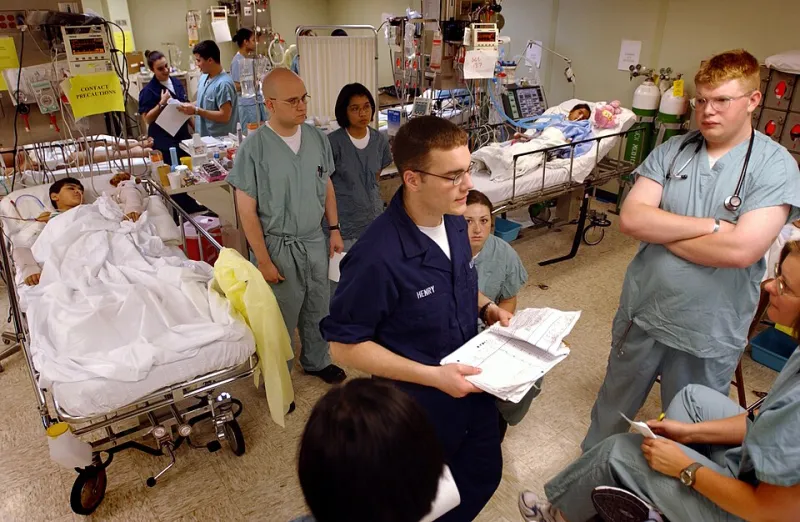
Photo: U.S. Navy photo by Photographer's Mate 1st Class Shane T. McCoy., Public domain, via Wikimedia Commons
There is a version of events that shows up in the incident report. A patient was found unresponsive at 03:47. Code was called. Interventions were performed. Time of death was noted. The report is accurate, and it is completely silent about the person who pushed open the door.
That person is the reason this article exists.
The Hour Nobody Plans For
Psych nurses talk about “the room” the way other people talk about a bad year — a fixed point on a timeline. Ask enough of them and a pattern emerges: the discovery, the count that starts in your head, the thirty seconds of hoping you're wrong, the sound of your own voice calling for help in a hallway that was quiet a moment before.
“I remember my hands more than anything,” says Dana, a night-shift RN in Ohio who found a patient in 2021 and still works inpatient. “I remember thinking, I have to be accurate, because whatever I do next goes in a chart that someone will read for years. So I did the job. And then I went and sat in the soiled utility room because it was the only door that locked.”
Her unit held a debrief the next morning. It ran nineteen minutes. The manager was kind. Someone brought bagels. By 7 a.m. the following day, the assignment board had no memory of it at all.
What “Second Victim” Actually Means
The phrase was coined in 2000 by Dr. Albert Wu, an anesthesiologist, to describe clinicians who are traumatized by an unanticipated patient event. The concept has since been studied in emergency medicine, obstetrics, and critical care. In psychiatric settings it arrives with a twist: the death may be the outcome a patient intended, which makes the grief harder to name and the sympathy harder to route. There is no family in the parking lot to hand a coffee to. There is no clear villain. There is only a nurse who is now somebody who found a patient.
“People kept saying, ‘it wasn't your fault,’” says Priya, an inpatient nurse in California. “I know it wasn't my fault. That's not what I needed. What I needed was for someone to say, ‘that was horrible and you saw it and it's going to live in you for a while.’ Nobody said that, because everyone was trying to fix my feelings instead of sitting with them.”
That gap — between reassurance and acknowledgment — is where most unit responses fall apart.
Why the Debrief Often Misses
The standard post-event debrief is designed for systems, not for people. It's usually convened within twenty-four hours, staffed by whoever is on shift, and structured around what the chart needs: timeline, protocol adherence, documentation. All of that matters. None of it is grief work.
Three problems show up repeatedly.
It's mandatory, so nobody is honest. A nurse who is afraid of being second-guessed does not say “I hadn't checked on them in forty minutes and I've been replaying that.” They say “checks were completed per policy.” The clinical facts get recorded. The human facts go into the parking lot.
It's public, so the newest nurse talks last. The people most affected are often the least senior, and the least senior people are the least likely to speak in a room containing their supervisor.
It's a single event. One conversation, once. Then everyone is expected to be at handoff at 0700 with a clear head, because the unit has twelve other patients who need exactly that.
What Peer-Led Support Looks Like When It Works
The programs that seem to land aren't elaborate. They're peer-delivered, voluntary, and unhurried.
At one East Coast hospital, a group of psych nurses built what they call a “first forty-eight” — a volunteer peer, not a supervisor, assigned to check in with the affected nurse twice in the first two days, off the unit, on the clock. The peer isn't a therapist. The peer is somebody who has opened a door like that one. Their only job is to ask three questions: How are you sleeping? What are you not saying in the debrief? What do you need on your next shift?
Another model: a standing weekly half-hour on the schedule labeled “unit group,” run by a psych NP, where the default agenda is nothing. Attendance is voluntary. Sometimes six people come and it's about a difficult admission. Sometimes one person comes and it's about a death from three weeks ago that nobody has asked about since.
“The thing that helped me most was a coworker who texted me a meme about a completely unrelated subject,” Dana says. “Not because it was funny. Because it meant I was still a person who existed outside that room.”
Four Policies That Change the Math
Words are cheap. Scheduling is where a unit proves what it believes.
1. Protected time off the unit immediately. Not a full shift of leave, necessarily — but a real block of hours where the nurse is relieved, off the floor, and not asked to finish charting first. Some units use an on-call “relief” slot specifically for this purpose.
2. Non-punitive review, stated out loud. A written, pre-existing policy that the discovery and immediate response will be reviewed for learning, not discipline, absent gross negligence or impairment. Say it in the room. Nurses who fear consequences do not grieve honestly, and units that fear disclosure do not learn.
3. Scheduled follow-up check-ins. One at seventy-two hours, one at two weeks, one at six weeks — by a peer, on the clock, documented as a brief contact note rather than a performance item. The six-week check-in is the one most units skip and most nurses remember needing.
4. A way back in. Some nurses want to return to the same assignment the next night. Some can't walk that hallway for a month. Both are legitimate, and both require a manager willing to trade schedule convenience for a human being.
A Manager's Checklist
- Relieve the nurse from the floor before asking for a statement.
- Ask, before the debrief, whether they want to attend or to give written input.
- Keep the clinical review and the emotional review in separate rooms.
- Assign a peer, not a supervisor, for the seventy-two-hour check-in.
- Tell the whole unit what support exists — so nobody has to ask for it in front of everyone.
- Track how many staff are affected per year. If it's more than zero, it's a budget line, not an exception.
- Follow up at six weeks. Put it on a calendar with a name attached.
The Part That Stays
Nobody in this work gets to un-see the thing they saw. The goal was never erasure. It's that a nurse who opens that door should not have to carry the rest of the shift, the next shift, and the following year in a hallway where everyone has decided the matter is closed.
Dana still works nights. She keeps a small clay bowl in her locker that a patient made in the art group years ago — not from that room, from a different one. “It's just a bowl,” she says. “But it means I've been here long enough to have good days too.”
Units that want to keep their psych nurses should learn to say the same thing out loud, in policy, and on the schedule: the person who found the patient is also a patient of this unit's care.