The Suit in the Break Room: What Happens When a Hospital Executive Works a Full Psych Shift
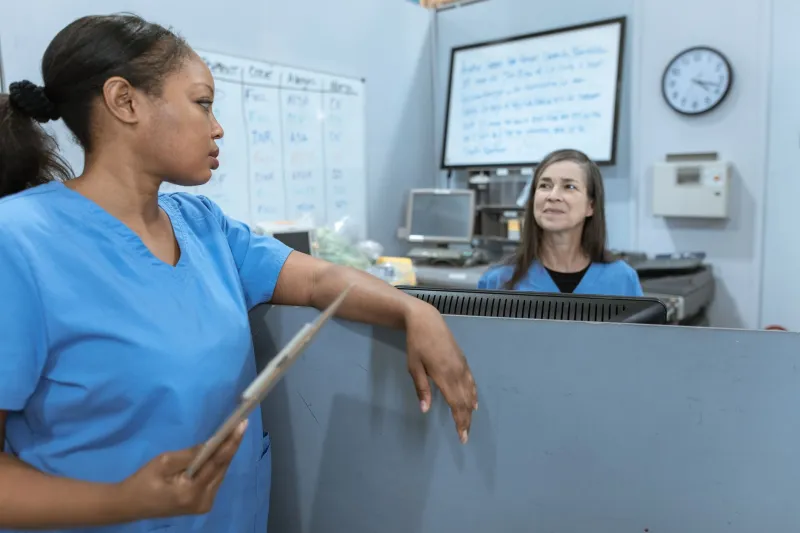
The hardest part, she thought, would be the doors. Two locked doors, a badge reader, a staff member who has to buzz you through both. Instead, the chief operating officer of a 340-bed nonprofit hospital in central Ohio found that the hardest part was standing still for eleven minutes while a patient decided whether she was allowed to sit down.
She was three hours into a twelve-hour shadow shift on the inpatient behavioral health unit, wearing borrowed scrubs and a visitor badge stamped ESCORT REQUIRED. Her guide for the day was a night-shift nurse with fourteen years on the unit who had volunteered — somewhat reluctantly — to show a vice president what the job actually is.
"I kept wanting to fill the silence," the COO said later, in a debrief that ran ninety minutes past its scheduled end. "And the nurse kept telling me, with her eyes, to stop talking."
The program, briefly
Executive immersion isn't new in American hospitals. Surgery chiefs have scrubbed in with OR teams for years, and plenty of health systems run "leader rounds" that amount to a walk-through with a clipboard. What's different about the psych-unit version — now running in some form at a handful of hospital systems, from the Midwest to the Pacific Northwest — is the duration and the boundary. A full shift. No phone. No early exit. And a written commitment, signed before the shift, that leadership will act on what it sees.
That last clause is the one that matters. Without it, the whole exercise turns into tourism.
At the central Ohio hospital, the program started after a staffing crisis in 2024 that briefly closed six of the unit's twenty-four beds. The chief nursing officer proposed the immersion idea; the COO, to her credit, volunteered first.
Hour one: the search
Every shift on an inpatient psych unit begins with a belongings search. The COO stood at the doorway of a patient's room while a tech inventoried a duffel bag: shoelaces, a phone charger, a spiral notebook, three pens (two confiscated), a photograph of a dog, and a belt. The patient, a man in his fifties on a voluntary hold, watched the whole thing with the flat patience of someone who has done it before.
"He wasn't angry," the COO said. "He was embarrassed. And I realized I had never once thought about what it feels like to have your shoelaces taken away as the first thing that happens to you."
That moment ended up in a slide deck a month later, in front of the hospital's quality committee. It's the kind of detail a spreadsheet will never surface.
Hour six: the part nobody puts in a job description
Mid-afternoon, a patient in the dayroom escalated. What struck the executive wasn't the escalation — it was everything around it. The way the nurse dropped her voice half an octave. The way the tech stepped to the side rather than forward, opening space instead of closing it. The way two other patients quietly moved to the far end of the room without being asked.
The whole thing was over in about four minutes. Nobody was touched. Nobody raised a hand. It looked, from the outside, like a conversation.
"I said to her afterward, 'That was incredible,'" the COO recalled. "And she said, 'That's Tuesday. That's just Tuesday.'"
This is the invisibility problem in a nutshell. De-escalation that works leaves no documentation trail, no incident report, no charge capture. It produces nothing measurable except a day that didn't go sideways. Administrators manage what they can measure, which means the most skilled thing that happens on a psych unit is often the thing least visible to the people who fund it.
Hour nine: the security question
Just past 3 p.m., the COO asked her nurse a practical question: how do you call for help in a hurry?
The answer was a wall-mounted call button in the hallway, a two-way radio shared by the charge nurse, and a phone tree that depended on someone at the desk hearing it ring. The unit had no panic button. The security team's response standard — written, approved, on file — said "as soon as possible."
"I had approved that language," the COO said. "I signed it. I don't remember signing it, but I know I did."
Within six weeks of the debrief, the standard read three minutes, with a quarterly drill and a log. The hospital also funded a second behavioral health technician on nights, adjusted the sitter ratio on the high-acuity side of the unit, and moved the annual ligature-risk audit out of the nursing budget and into facilities, where it arguably always belonged.
Those are modest changes. Nobody is claiming a revolution. But they were specific, budgeted, and traceable to a single Tuesday in March — which is more than most employee-satisfaction surveys can say.
What the nurses got out of it
Here's the part the executives didn't expect: the staff wanted the program to continue. Not because they enjoyed being observed, but because for once someone with budget authority had seen the thing they'd been describing in huddles for years.
"We've been saying we need a second tech on nights since 2019," one nurse said. "Turns out all we needed was for someone to stand in the hallway at three in the morning and feel it."
If your unit wants to try this
A few lessons the participating hospitals passed along:
- Get the commitment in writing. Not a promise to "consider" — a written commitment to respond to the debrief within sixty days, with a named owner.
- Let staff set the rules. The nurse, not the executive, decides what the executive can and can't do. No charting. No therapeutic groups. Hands-off during any escalation.
- Debrief twice. Once immediately, with the nurse, and once two weeks later, in a room with food and the unit's actual leadership.
- Publish the follow-up. Even the boring parts. Especially the parts where leadership says no and explains why.
- Don't make it a photo op. The hospitals that got the most from this banned communications staff from the unit entirely.
Recognition, in mental health nursing, is often reduced to a plaque and a lukewarm sheet cake. Immersion is a different proposition: it asks leadership to be uncomfortable in public, and then to convert that discomfort into something with a line item attached.
The COO in Ohio still keeps her visitor badge in a desk drawer. She says she looks at it before every staffing meeting.
"It's not a souvenir," she said. "It's a reminder that I've been in that hallway. And I know what it costs to be short-staffed in there."